

Short-term rental in Russia can generate good money, but you need to know exactly what you’re getting into – otherwise you’re walking on thin ice.
Now that it’s become more difficult for Russians to obtain visas for EU countries, domestic tourism has exploded, especially in cities like St. Petersburg and Kaliningrad. Because hotels are unreasonably expensive, particularly during peak season, many tourists opt to stay in apartments. As a result, short-term rental operators are often doing great business.
But is short-term rental in Russia really an attractive business model? It’s a sector where many entrepreneurs don’t take the rules very seriously. However, you can definitely make good money while staying completely within the law – but you need to approach it the right way.
Table of Contents
- What constitutes short-term rental in Russia?
- Ban on ‘hotel services’ in apartment complexes
- Legal boundaries
- What are hotel services?
- Consequences of being classified as hotel services
- History of the ‘anti-hostel law’
- Hotel service or not?
- Avoiding hotel service classification
- Practice in Moscow and St. Petersburg
- Zoning changes
- Taxes and registration requirements for landlords
- Legal structures: ИП vs ООО
- Property tax
- Conclusion
Platforms
Since Airbnb and Booking.com withdrew from the Russian market, landlords have switched to domestic platforms such as:
- Yandex.Travel (Яндекс Путешествия)
- Sutochno.ru (Суточно.ру)
- Avito Nedvizhimost (Авито Недвижимость)
- Tvil.ru (Твил.ру)
What constitutes short-term rental in Russia?
Short-term rental in Russia typically refers to renting out (residential) space for a period of one day to several weeks. This type of rental is often used in cities with many tourists or business travelers.
Ban on ‘hotel services’ in apartment complexes
Article 17, paragraph 3 of Russia’s Housing Law prohibits offering ‘hotel services’ in residential spaces within apartment complexes.
Legal boundaries
When it comes to short-term rental of residential space, legally speaking there’s essentially no difference from long-term rental (the same rules as in my blog about residential rental apply), unless the space is being used to offer ‘hotel services.’
When it comes to renting non-residential space, the rules of the category to which the space belongs apply. The prohibition in Article 17, paragraph 3 of the Russian Housing Law on offering hotel services only applies to residential space. However, this doesn’t mean you can do whatever you want with other spaces – your freedom to use the space in some way is greater than with residential space. There’s at least no explicit prohibition.
What are hotel services?
In Article 1 of the Law on ‘The fundamentals of tourist activities in the Russian Federation,’ hotel services are defined as: a package of services aimed at temporarily accommodating persons in a hotel, supplemented with other services as established in the official Russian rules for hotel activities. These may only be offered by individual entrepreneurs (ИП) and legal entities (ООО) with proper registration.
Consequences of being classified as hotel services
First, there’s the prohibition in Article 17, paragraph 3. If your rental services are suddenly classified as hotel services and it’s residential space you’re renting, you may no longer rent this space.
A hotel service provider has more obligations than someone who merely rents out an apartment. Below is a limited list:
Mandatory registration as an entrepreneur You may rent your home in Russia without being registered as an entrepreneur, but if your rental is classified as hotel services, registration as an entrepreneur/business is mandatory.
Mandatory classification: Offering hotel services is only permitted if the accommodation has a valid classification. This classification is awarded in accordance with the federal law “On the foundations of tourist activities in the Russian Federation.”
The service provider must provide specific information in an accessible form to the consumer. This information must be displayed on a sign at the entrance or in the space designated for guest check-in and can also be published on the hotel’s website. Required information includes:
- The name and address of the service provider (legal entity, branch or individual entrepreneur), including registration details and tax identification number
- The unique registration number of the accommodation from the register of classified facilities, a link to online registration and details about the assigned category
- Information about room categories and their prices
- A list of services included in the room price
- Information about the form of payment for hotel services
- Information about the form, conditions and procedure for booking, as well as cancellation conditions
- Check-in time and check-out time
Mandatory free services: The service provider must offer certain services free of charge upon request, including calling an ambulance, providing a medical kit, delivering mail, providing wake-up calls and supplying boiling water.
History of the ‘anti-hostel law’
The ban on hotel services in residential spaces in apartment complexes was already proposed in 2014 by parliamentarian Galina Khovanskaya. This proposal was often described in the media as the ‘anti-hostel law’ or the ‘Khovanskaya law.’
The bill immediately faced fierce criticism, and in 2016 in St. Petersburg, hundreds of owners of small hotels and hostels even organized a protest against this law.
Nevertheless, Article 17, paragraph 3 of the Housing Law was amended (eventually only in 2019).
Looking at the law’s history, however, it’s clear that it was aimed at nuisance caused by hostels and mini-hotels in residential buildings, and not so much against people who rent out entire apartments. But this latter group can still face problems due to the anti-hostel law.
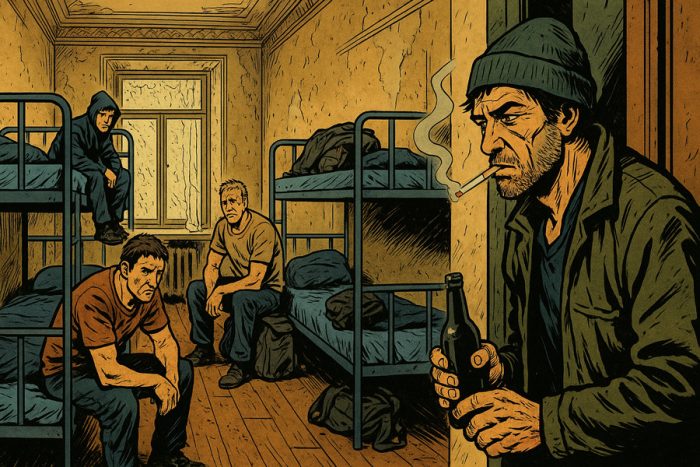
You have to imagine that apartments in classic city buildings in a city like St. Petersburg often have dimensions of more than 200 square meters. If you fill several rooms in such an apartment with bunk beds (and this was often done), this indeed often led to more than doubling the number of residents in a building.
Hotel service or not?
The legislator left little unclear with the prohibition in Article 17, paragraph 3. And, as often happens, the courts had to step in to provide more clarity.
In an authoritative ruling by Russia’s Constitutional Court (КС РФ) in October 2023, this court determined that:
Renting a home on a daily basis can be completely legal and doesn’t automatically have to be considered hotel activity — as long as it involves actual use as residential space, without significant nuisance to other residents.
According to the Court, it’s crucial that:
- the home is not structurally operated as a hotel
- no additional services are offered (such as cleaning, breakfast, reception)
- and tenant behavior doesn’t cause excessive nuisance to other residents in the building
Reading the ruling, it seems the Constitutional Court wasn’t entirely sure what to do with itself either. In the ruling, it explicitly asks the legislator to come up with clearer rules, which hasn’t happened yet.
The Constitutional Court’s criterion that tenant behavior shouldn’t cause excessive nuisance to other building residents naturally seems extremely subjective. While the court tries to clarify this by discussing excessive burden on public spaces, it nevertheless remains vague.
Reducing the risk of hotel service classification
If you want to rent your Russian apartment short-term in a safe way – meaning without being seen as a hotel service provider – you can:
- Better not offer additional services, such as breakfast and airport pickup
- Do your best to ensure your tenants don’t cause nuisance
Additionally, the following things are suspicious:
- Reception or staff active in shared spaces
- Advertising as ‘hostel,’ ‘hotel,’ or ‘apart-hotel’
- Rental of multiple units simultaneously by one owner
- Rental accompanied by structural complaints from neighbors
However, you can’t control your tenants (or your neighbors), so risks can’t be completely eliminated.
Practice in Moscow and St. Petersburg
Although the rules are unclear, rental of entire apartments for short terms in St. Petersburg or Moscow is tolerated.
Zoning changes
Despite everything, it’s still allowed in certain cases to have a hostel in an apartment complex in Russia.
Article 17, paragraph 3 contains a prohibition on offering hotel services in residential space. However, in certain cases in Russia it’s possible to have residential space rezoned and make it commercial real estate.
If you want to convert a home in Russia to non-residential real estate (from жилое помещение to нежилое помещение), you must meet several legal conditions. According to the Civil Code and Housing Law of the Russian Federation, these are:
Ownership and location on the right floor The property must be fully owned by the person requesting the change, and be located on the ground floor. If it’s on a higher floor, conversion is only possible if the underlying floors already have non-residential zoning.
Own, separate entrance The property must have a separate entrance, completely separated from stairwells, entrance halls and other spaces that provide access to residential floors. If there’s no separate entrance yet, there must at least be a technical possibility to create one (without damage to the building).
No residents or registered persons No one may be registered at the address and no one may actually live in the space.
No restrictions or third-party rights The space may not be encumbered with third-party rights, such as a mortgage, lease agreement or other property right that restricts free use.
Separate written consent from all directly adjacent neighbors (above, below and next to the property)
If your property doesn’t yet have its own separate entrance, permission from the homeowners association is also needed to create one. Converting residential to non-residential real estate is therefore not simple, so owners are advised to engage with neighbors early to remove objections, possibly by offering financial compensation or engaging a mediator.
Taxes and registration requirements for landlords
To determine how attractive short-term rental in Russia actually is, insight into the tax burden is naturally essential.
Anyone earning income from short-term rental in Russia — even as a foreigner — must account for fiscal and administrative obligations. Russian law distinguishes different scenarios, depending on the scale of rental and whether you do this as a private individual, self-employed (самозанятый) or entrepreneur (ИП or ООО).
1. Taxes for natural persons (private individuals)
Starting January 1, 2025, Russia’s income tax system for natural persons (without registration as entrepreneurs) became progressive. The rates are now as follows:
- 13% for annual income up to 2.4 million rubles
- 15% for the portion of income between 2.4 million and 5 million rubles
- 18% for the portion between 5 million and 20 million rubles
- 20% for the portion between 20 million and 50 million rubles
- 22% for the portion above 50 million rubles
These rates apply to active income, such as salaries and rental income. For passive income, such as dividends and interest, the rates of 13% and 15% continue to apply, depending on the amount.
For non-residents, the tax rate is 30%!
If you’re not a fiscal resident of Russia, it’s often not advantageous to rent without being an entrepreneur. Especially not for short-term rentals, where you incur costs for cleaning and such, which you can’t deduct here.
2. Self-employed status: самозанятый (self-employed regime)
I’ve gone deeper into this status in this blog post. Obtaining this status isn’t possible for most foreigners. Currently, it’s only available to people with Russian nationality or people with nationality from one of the Eurasian Economic Union countries.
But for completeness, these people can pay according to the following rates:
- 4% when renting to private individuals
- 6% when renting to companies
They also enjoy the following benefits:
- No bookkeeping or VAT obligations
- Registration can be done simply via the My Tax app (Мой налог)
3. Registration as entrepreneur (ИП) or company (ООО)
When you rent structurally, professionally (for example, multiple apartments, with extra services), this is classified as commercial activity. In that case, you’re required to register as an individual entrepreneur or establish a legal entity. Tax rates and obligations differ per regime, but the most commonly used option is 6% on turnover via the simplified system.
- Mandatory for structural, commercial rental (such as multiple objects, regular rental, additional services)
- Possibility to choose tax regime (for example УСН 6% of turnover)
- More obligations: bookkeeping, reporting, registration with tax service and social funds
Property Tax
Because it’s more advantageous in many countries to own real estate as a company, many expect this to be the case in Russia too. But that’s absolutely not the case. One of the main reasons for this is the high Property Tax for companies in Russia.
The table below compares property tax rates for various real estate objects in Moscow and St. Petersburg (regions can set their own rates within certain limits in Russia). Just by looking at this table, much will probably become clear.
| Owner Type | Property Type | Region | 2025 Rate | Official Source |
|---|---|---|---|---|
| Natural Person | Residential | St. Petersburg | 0.1% (fixed rate) | Art. 406 NK RF (residential homes/apartments: max. 0.1% according to federal law) |
| Natural Person | Residential | Moscow | 0.1% – 0.3% (progressive) | Moscow Law: up to 10 mln ₽ → 0.1%; 10–20 mln ₽ → 0.15%; 20–50 mln ₽ → 0.2%; 50–300 mln ₽ → 0.3% |
| Natural Person | Non-residential | St. Petersburg | 0.5% (standard); 2% for certain commercial/valuable objects | Art. 406 NK RF (other objects: 0.5%; special category commercial/expensive real estate: up to 2% allowed) |
| Natural Person | Non-residential | Moscow | 0.5% (standard); 2% for certain commercial/valuable objects | Art. 406 NK RF (other objects: 0.5%; special list/ >300 mln ₽: up to 2%) |
| Legal Entity | Residential | St. Petersburg | 1.5% (fixed rate) | St. Petersburg Law (Objects with cadastral basis; residential objects fall under 1.5%) |
| Legal Entity | Residential | Moscow | 2.0% (fixed rate) | Moscow Law (Objects with cadastral value basis are taxed at 2.0% rate) |
| Legal Entity | Non-residential | St. Petersburg | 1.5% standard; 2.5% for very large objects | St. Petersburg Law (commercial/non-residential real estate: 1.5%; top rate 2.5% at cadastral value > 10 bln ₽) |
| Legal Entity | Non-residential | Moscow | 2.0% (fixed rate) | Moscow Law (commercial/non-residential real estate on cadastral basis: 2.0%) |
Conclusion
Short-term rental in Russia can indeed generate good money, especially now that domestic tourism has grown so strongly due to visa restrictions for EU countries. The profitability is attractive: with progressive tax rates starting at 13% for natural persons and opportunities for entrepreneurs to choose the simplified system (6% on turnover), there are certainly financial opportunities. However, you do need to know exactly what you’re getting into, otherwise you’re walking on thin ice.
The biggest problem is the lack of legal certainty that current legislation provides. The ‘anti-hostel law’ in Article 17, paragraph 3 of the Housing Law does prohibit hotel services in residential space, but what exactly constitutes hotel services remains unclear. Even the Constitutional Court recognized this ambiguity in 2023 and called on the legislator for clear rules – something that hasn’t happened yet. This uncertainty makes it difficult to invest in short-term rental with confidence.
To understand these rules properly, we must place them in their historical context. The law was originally aimed at nuisance from hostels and mini-hotels in residential buildings – especially those bunk bed constructions in large apartments in cities like St. Petersburg that more than doubled the number of residents. The legislation was thus not primarily intended to hinder people renting out entire apartments, but due to vague formulation, they too can become victims.
For entrepreneurs who really want to open a hostel or hotel, there’s really only one reliable option: rezoning residential space to non-residential real estate. However, this process is complex and requires, among other things, a separate entrance, consent from all direct neighbors, and the property must be on the ground floor (or all underlying floors must already be non-residential).
Van Rhijn Legal & Property can help you with all aspects of this process: buying a suitable property, renting a suitable property, and changing the zoning of a property – where this is possible. It’s important to realize that rezoning isn’t always possible, and early legal advice can save you much time, money and disappointment.
Practice shows that rental of complete apartments in Moscow and St. Petersburg is tolerated, as long as you don’t offer additional hotel-like services and ensure tenants don’t cause nuisance. But without clear legal frameworks, this remains a venture with inherent risks.
In short: short-term rental in Russia certainly offers opportunities for good profits, but requires a thoughtful approach and solid legal preparation. The golden rule remains: make sure you know exactly what you’re getting into before you invest.
Prefer audio? We discuss this subject in detail in our latest podcast episode:


